You don’t have to spend long on the internet, or basically anywhere youth congregates, to realise the past is undeniably present. Nostalgia is nothing new, but it takes on a certain potency in an algorithmic world; Spotify directs teens to Nirvana, Led Zeppelin and Elvis; gone are the days when tuned-in older relatives or friends were required to nurture tomorrow’s punks by handing down their music taste. Meanwhile there are fortunes to be made by tweens documenting their ironic updates of Y2K fashion online. 90s supermodels rule digital mood boards; 80s horror rules film and TV. I am not trying to suggest cyber-fuelled nostalgia is a cause for concern, but it is interesting to compare with the feeling in the air around the new millennium. On the cusp of the 21st century rested fear of the nostalgia mode, paranoia over technology controlling culture and sadness for a future which will not come. This angst radiates from Radiohead’s 1997 album, OK Computer – a case study for hauntology and retromania at the turn of the millennium.
Words like hauntology are spiked with pretension, but I think they point to ideas which are so innate to us that they remain in our subconscious, without the need for language to describe them. Hauntology, coined by Jacques Derrida, is essentially the inverse of ontology – the philosophical study of being. Ontologists try to understand what defines existence, what is present in our reality. Hauntology, meanwhile, is a view of the world structured by absence – by what is no longer, or is yet to come. The late, great Mark Fisher describes the “haunting” of the digital age as “a failed mourning [of] all the lost futures that the twentieth century taught us to anticipate” (Fisher, 2012). Cultural revolutions which media promised were inevitable, but never came; musical innovation that fizzled out before it had begun; the abandoned expanses of a world riding high on a century which had seen more exponential growth in population, technology and connectivity than ever before. For hauntologists like Fisher, 21st century culture seems dormant; time & space collapse, as old culture is recast as new, and new culture seems indistinguishable from the old. Retromania reinforces this sense of cultural depression in a world deprived of “the shock of the new” (Donnelly, 2022). It is used to describe a pathological fixation on the past. According to retromania scholars, music, film and fashion recycle existing styles and inherited forms, opting to numb consumers with the familiar, rather than innovate (Adorno, 1944).
But where amidst this jargon do we find Radiohead, the band who squirmed under their reputation for intellectual rock, always distancing themselves from the culture machine with grouchy indifference? In 1997, they had been on tour for 4 years, and constant motion had created a sense of “isolation and dissociation from reality” (Middle 8). As the world transitioned from an analogue to a digital age, humans and robots seemed increasingly alike. The band was evidently suspicious of the dawn of a new cyber reality. OK Computer breaks away from their previous work, ironically combining pop-rock & “electronic distortion” (Hugonnier, 2019). Through its cover art, lyrics and formatting, the album paradoxically becomes a machine-made consumer product (Hugonnier, 2019) – the very thing it criticises – thereby painting ‘a dystopian vision of the world post 2000’ (Middle 8).
The band has been caught between retromania and hauntology – you could describe them as haunted by their influences. They spent much of the 90s resisting the Britpop label – this was a genre which drew heavily on classic British rock, glam and punk rock, as well as the New Wave of the 80s. Radiohead shared many of these influences, and even their moody disillusionment was mirrored their predecessors. Still they resisted backtracking. Their choice was to reject postmodern chaos in favour of high modernism – to blend genres and make something new. They are less concerned with imitation than a “referential galaxy” (Lassauzet, 2019) of jazz, rock, pop, electronic music, cinema and literature. Haunting is evident when the band dedicates songs to artists who have inspired them during live shows (Lassauzet, 2019). Ultimately, said singer Thom Yorke, they aimed to gather strains of influence to “[express] something cumulatively” (Lassauzet, 2019).
And the content of their message? To start, the band offers an indictment of consumer culture’s monotonous daily grind. The track ‘Fitter Happier’ is two minutes of a computerised voice listing adjectives which describe the kind of life to which the modern consumer is meant to aspire:
‘Fitter happier
(Yorke, 1997)
Comfortable
Not drinking too much
Regular exercise at the gym (3 days a week)
Getting on better with your associate employee contemporaries
At ease
A pig
In a cage
On antibiotics.’
The monotonous voice and melancholic piano keys create a sense of depressed claustrophobia. Radiohead’s fears of a complacent, tech-driven future suggest that spectres of expectation prevent us from settling into the “sickening comfort” (Hugonnier, 2019) of “a world governed by capitalist realism” (Fisher, 2012). It captures the transience & “eerie loneliness of modern life” (Hugonnier, 2019). Its messages have only become more prescient, as we arguably have lost to the machines and are now drowning the sorrows of our overstimulated minds in nostalgia.
The power of the album is that its haunting is not merely atmospheric – Radiohead anticipates ‘an imagined future undone by the technology designed to save it’ (Hilton, 2017). It exists outside of fixed space and time (Lassauzet, 2019) with themes ahead of the culture which produced it and a kind of humanity which stretches across an increasingly globalised world. Still, I would argue that hope remains. If we continue to engage with art – whether from the 30s, 90s, or today – which challenges our perceptions, we can break from monoculture and find the energy of innovation. This energy might be supported by machines, but ultimately can empower the human voice to speak truthfully.
The quest for authentic living, for a sense of community and humanity, is leading us to some interesting places and ethical dilemmas. When I say us, I speak for my generation of young people, particularly those who like to think of themselves as a little more culturally conscious (read: pretentious).
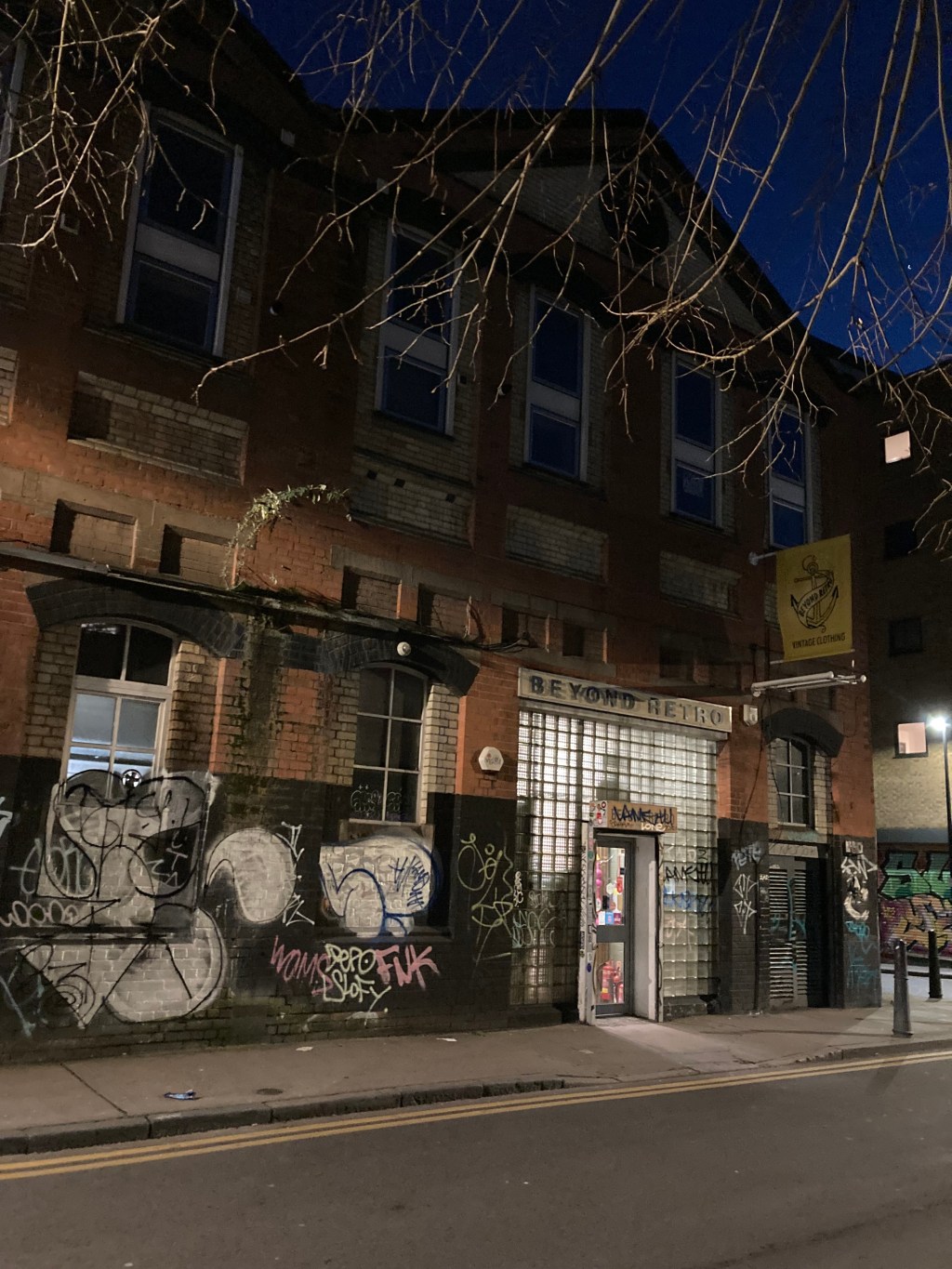
The image at the top of this post was taken in Chesire Street, just off Brick Lane. It strikes me as melancholic, yet peaceful and slightly hopeful too. These tend to be my feelings when pounding East London’s pavements. There is the shameful knowledge of gentrification, whose existence is underlined by the roaring trade Beyond Retro and other vintage stores do each weekend. Tourists and locals alike flock to the area to buy vinyl records and bagels in the shadow of former slum dwellings. That is the nature of the city, I know – to change. Certainly many of the changes to East London in the past few decades reveal a ruthless expulsion of lower-income communities from their space on the edge of the City. This displacement is undeniable.
At the same time, one can idealise places like Tower Hamlets today. The shining light of multicultural London, bearing its history proudly with blue plaques, celebrating its street markets and beautiful mosques with murals in Whitechapel station, accommodating multi-generational families, art students and digital freelancers in former council estates. The Columbia Road Flower Market recalls simpler times, with its quaint stalls and row of tenement homes out of a period drama. One can become lost whilst browsing vinyl records and eating beigels, in memory of the Jewish immigrants who defied Oswald Moseley and built their lives in the East End.
But a vision of the new East London, integrated utopia, can only be a lost future. If the current state of housing is anything to go by, those without the money to compete with investors will be pushed to the furthest reaches of the Elizabeth line. The upper-class, vintage-clad youth who remain will continue to reminisce on the last days of analogue. They will listen to Bob Dylan and Prince and Britney Spears (all on the same playlist!), fondly reflecting on their parents’ tape collections and the first CDs they bought. They will know, instinctively, that there will be no more Gil Scott Herons; they will know the rules of the game – that is, that the hands of the music industry itself are tied; too much changed has change – profit is too important. Virality is too vital. Marketability, based on proven success, is too sensible to reject.
Or perhaps not? As ready as I am to give into pessimism, I cannot ignore how naïeve and simplistic this view may be, given the fact that culture’s commercialisation has been decried for decades. The scholar Simon Fisher argues there has been no overwhelming wave of musical rebellion since the last days of the rave; I would tend to agree. But who is to say that hyper pop won’t invigorate this century’s roaring twenties, once it has been fully discharged from quarantine? The power of music has already seen K-Pop fans (allegedly) drain the auditorium of a Trump rally; who’s to say art has been lost to nostalgia and the machines feeding it to us?
The longer I reflect on these things, the more I am at a loss. I am still struggling to grasp the connection between Radiohead, Chesire Street and Fisher’s lost futures. I am sure it is there, even if I have failed to articulate it clearly. I hope for continued innovation, and I hope for neighbourhoods which allow diverse communities to participate in the thrill of urban life, rather than reserving city living for the privileged. I hope we can look back on culture without feeling as though it will never progress further.
I should note that the Beyond Retro branch pictured above seems to have closed since I took this photo. Whose victory and whose loss this, I do not know, and will leave you to decide.
***
Many thanks to the following sources:
Adorno, T.W. (1944) ‘The Culture Industry: Enlightenment as Mass Deception’, in Dialectic of Enlightenment [Online]. Available at: https://web-s-ebscohost-com.stmarys.idm.oclc.org/ehost/detail/detail?vid=0&sid=256d1b9d-a4dd-4402-a5dd-7a88dac9bc33%40redis&bdata=JnNpdGU9ZWhvc3QtbGl2ZQ%3d%3d#AN=1055340&db=e000xww (Accessed 14 June 2020).
Evelyn, K. (2020) ‘Trump ‘played’ by K-pop fans and TikTok users who disrupted Tulsa rally’ [Online] Available at: https://www.theguardian.com/us-news/2020/jun/21/trump-tulsa-rally-scheme-k-pop-fans-tiktok-users (Accessed 3 May 2022).
Fisher, Mark (2012) ‘What is Hauntology?’ Film Quarterly 66 (1) [Online] Available at: https://www-proquest-com.stmarys.idm.oclc.org/docview/1287739820?pq-origsite=summon (Accessed 11 July 2022).
Fisher, Mark (2014) ‘Ghosts of my life: writings on depression, hauntology and lost futures’ Zero Books [Online] Available at: https://www.vlebooks.com/Product/Index/839283?page=0 (Accessed 11 July 2022).
Gig Archive (2020) ‘Inside Radiohead – MTV Documentary, 1997’ (HQ) [Online video] Available at: https://www.youtube.com/watch?v=-Nrb5ffQckM (Accessed 6 July 2022).
Hilton, R. (2017) ‘Hear Radiohead Talk About ‘OK Computer’ In A 1997 Interview’ NPR [Online] Available at: https://www-proquest-com.stmarys.idm.oclc.org/docview/1912783969?pq-origsite=summon (Accessed 6 July 2022).
Hubbs, N. (2008) ‘ The Music and Art of Radiohead; Radiohead’s OK Computer’ Popular Music 27(3) [Online] Available at: https://www.proquest.com/docview/195179603/fulltextPDF/664A6A5B2B714577PQ/1?accountid=30360 (Accessed 6 July 2022).
Hugonnier, F. (2019) ‘“aaaaaaaaaaaaaaaaaaaaaaaaaambition makes you look [pretty] ugly”: Mass consumption and computer-generated art in Radiohead’s OK Computer’ Revue Lisa XVII (1) [Online] Available at: https://journals.openedition.org/lisa/10715 (Accessed 6 July 2022).
Lassauzet, B. (2019) ‘OK Computer and Radiohead’s creation of a syncretic rock music’ Revue Lisa XVII (1) [Online] Available at: https://journals.openedition.org/lisa/10819 (Accessed 5 July 2022).
 LIMEHOUSE BLUES
Leave a comment